After two posts with the title of “Tribulation Timeline” I guess it’s about time I have an actual timeline on screen related to the tribulation. I’ll get to that in a few minutes.
If you haven’t watched my first two videos or read the first two blogs with this title, I encourage you to do that – but you don’t need to do that before watching this video. Nevertheless, I’ll share a link below, in case you want to go back and watch them.

Appointed Times and Feasts: what in the world does that mean? I think there’s an idea that exists, specifically among protestant Christians, that feast times and seemingly overly traditional events are not meant for us. Passover, the Day of Atonement, these are all for the Israel – they don’t apply to us. And that’s partially true, but not fully true. Today I want to explore what these are, what they mean, how they apply to us, and why they are extremely relevant to eschatological events. I’ll also touch on why I believe one of these feasts point to a specific day Jesus will return.
In the Hebrew Scriptures (specifically in Leviticus 23), there are seven primary “feasts of the LORD.” They are often referred to as God’s appointed festivals. In Hebrew, the word is Moedim or Appointed Times. God says these are “his feasts” and “his appointed times”
Here is what Leviticus 23 says:
Starting in verse 2 we read:
Speak to the people of Israel and say to them, These are the appointed feasts of the LORD that you shall proclaim as holy convocations; they are my appointed feasts.
Notice here, the word convocations – it can mean a lot of things: Calling, assembly, reading – but it can also mean a rehearsal. Israel is called to practice for something.

In the first month, on the fourteenth day of the month at twilight, is the LORD’s Passover.
And on the fifteenth day of the same month is the Feast of Unleavened Bread to the LORD; for seven days you shall eat unleavened bread.
On the first day you shall have a holy convocation; you shall not do any ordinary work.
But you shall present a food offering to the LORD for seven days. On the seventh day is a holy convocation; you shall not do any ordinary work.”
And the LORD spoke to Moses, saying,
“Speak to the people of Israel and say to them, When you come into the land that I give you and reap its harvest, you shall bring the sheaf of the firstfruits of your harvest to the priest,
and he shall wave the sheaf before the LORD, so that you may be accepted. On the day after the Sabbath the priest shall wave it.
And on the day when you wave the sheaf, you shall offer a male lamb a year old without blemish as a burnt offering to the LORD.
And the grain offering with it shall be two tenths of an ephah of fine flour mixed with oil, a food offering to the LORD with a pleasing aroma, and the drink offering with it shall be of wine, a fourth of a hin.
And you shall eat neither bread nor grain parched or fresh until this same day, until you have brought the offering of your God: it is a statute forever throughout your generations in all your dwellings.
“You shall count seven full weeks from the day after the Sabbath, from the day that you brought the sheaf of the wave offering.
You shall count fifty days to the day after the seventh Sabbath. Then you shall present a grain offering of new grain to the LORD.
You shall bring from your dwelling places two loaves of bread to be waved, made of two tenths of an ephah. They shall be of fine flour, and they shall be baked with leaven, as firstfruits to the LORD.
And you shall present with the bread seven lambs a year old without blemish, and one bull from the herd and two rams. They shall be a burnt offering to the LORD, with their grain offering and their drink offerings, a food offering with a pleasing aroma to the LORD.
And you shall offer one male goat for a sin offering, and two male lambs a year old as a sacrifice of peace offerings.
And the priest shall wave them with the bread of the firstfruits for a wave offering before the LORD, with the two lambs: they shall be holy to the LORD for the priest.
And you shall make a proclamation on the same day. You shall hold a holy convocation. You shall not do any ordinary work. It is a statute forever in all your dwelling places throughout your generations.
“And when you reap the harvest of your land, you shall not reap your field right up to its edge, nor shall you gather the gleanings after your harvest. You shall leave them for the poor and for the sojourner: I am the LORD your God.”
And the LORD spoke to Moses, saying,
“Speak to the people of Israel, saying, In the seventh month, on the first day of the month, you shall observe a day of solemn rest, a memorial proclaimed with blast of trumpets, a holy convocation.
You shall not do any ordinary work, and you shall present a food offering to the LORD.”
And the LORD spoke to Moses, saying,
“Now on the tenth day of this seventh month is the Day of Atonement. It shall be for you a time of holy convocation, and you shall afflict yourselves and present a food offering to the LORD.
And you shall not do any work on that very day, for it is a Day of Atonement, to make atonement for you before the LORD your God.
For whoever is not afflicted on that very day shall be cut off from his people.
And whoever does any work on that very day, that person I will destroy from among his people.
You shall not do any work. It is a statute forever throughout your generations in all your dwelling places.
It shall be to you a Sabbath of solemn rest, and you shall afflict yourselves. On the ninth day of the month beginning at evening, from evening to evening shall you keep your Sabbath.”
And the LORD spoke to Moses, saying,
“Speak to the people of Israel, saying, On the fifteenth day of this seventh month and for seven days is the Feast of Booths[fn] to the LORD.
On the first day shall be a holy convocation; you shall not do any ordinary work.
For seven days you shall present food offerings to the LORD. On the eighth day you shall hold a holy convocation and present a food offering to the LORD. It is a solemn assembly; you shall not do any ordinary work.
“These are the appointed feasts of the LORD, which you shall proclaim as times of holy convocation, for presenting to the LORD food offerings, burnt offerings and grain offerings, sacrifices and drink offerings, each on its proper day,
besides the LORD’s Sabbaths and besides your gifts and besides all your vow offerings and besides all your freewill offerings, which you give to the LORD.
“On the fifteenth day of the seventh month, when you have gathered in the produce of the land, you shall celebrate the feast of the LORD seven days. On the first day shall be a solemn rest, and on the eighth day shall be a solemn rest.
And you shall take on the first day the fruit of splendid trees, branches of palm trees and boughs of leafy trees and willows of the brook, and you shall rejoice before the LORD your God seven days.
You shall celebrate it as a feast to the LORD for seven days in the year. It is a statute forever throughout your generations; you shall celebrate it in the seventh month.
You shall dwell in booths for seven days. All native Israelites shall dwell in booths,
that your generations may know that I made the people of Israel dwell in booths when I brought them out of the land of Egypt: I am the LORD your God.”
Thus Moses declared to the people of Israel the appointed feasts of the LORD.
Let’s quickly recap. These feasts are:
- Passover – verse 5
- Feast of Unleavened Bread – verses 6-8
- Feast of Firstfruits – verses 9-14
- Feast of Weeks (Pentecost or Shavuot) – verses 15-22
- Feast of Trumpets (Yom Teruah) – verses 23-25
- Day of Atonement (Yom Kippur) – verses 26-32
- Feast of Tabernacles (Sukkot) – verses 33-43
Passover commemorates the Israelites’ deliverance from Egyptian slavery. It is marked by the Passover meal (Seder) and focuses on themes of redemption and God’s protection.
Unleavened Bread immediately follows Passover and lasts seven days. Leaven (yeast) is removed from the home to symbolize separation from sin and corruption.
Firstfruits takes place during Unleavened Bread and celebrates the earliest barley harvest, giving thanks to God as provider.
Feast of Weeks (Pentecost or Shavuot) comes 50 days after Firstfruits. It marks the wheat harvest and, in Jewish tradition, commemorates the giving of the Torah at Mount Sinai. However, it’s interesting to note that on Pentecost, the Holy Spirit descended upon the hearts of men on the same day that the Mosaic Law was given.
Feast of Trumpets (Yom Teruah) begins the fall festivals with trumpet blasts, calling God’s people to repentance and preparation for the solemn Day of Atonement.
Day of Atonement (Yom Kippur) is a day of fasting and repentance. It emphasizes reconciliation with God and others, seeking forgiveness and purification.
Feast of Tabernacles (Sukkot) is a joyous weeklong festival remembering the Israelites’ journey in the wilderness. People often build and dwell in temporary shelters (sukkot) as a reminder of God’s provision.
The Four Feasts Jesus Fulfilled
1. Passover
The Jewish religious calendar begins in the spring on Nisan 1, commemorating Israel’s deliverance from Egypt (Exodus 12:1-2). Two weeks later, the first of the sacred assemblies, Passover, is observed. The Jewish calendar follows a lunar cycle, causing the date of Nisan 1 to shift between March and April in the Gregorian calendar. While Rosh Hashanah, observed in the fall, is often associated with the Jewish New Year, the biblical year begins in the spring.
Passover commemorates God’s deliverance of the Israelites from slavery in Egypt. On the night of the tenth plague, God commanded the Israelites to sacrifice a lamb and mark their doorposts with its blood so that the Destroyer would pass over their homes, sparing their firstborn sons (Exodus 12:12-13). Since the destruction of the Second Temple in AD 70, the traditional Passover lamb sacrifices have ceased (Rosenfeld, n.d.).
Jesus fulfilled the symbolism of the Passover lamb through His sacrificial death. On the night before His crucifixion, He shared the Passover meal with His disciples, instituting the New Covenant (Luke 22:14-20). He was crucified on the day of Passover, and the Gospel of John explicitly connects this event to Old Testament prophecy, stating that His bones were not broken, just as the Passover lamb’s bones were to remain unbroken (John 19:33, 36; Exodus 12:46). Paul affirms this connection: “For Christ, our Passover lamb, has been sacrificed” (1 Corinthians 5:7, ESV). Just as the blood of the Passover lamb saved the Israelites from physical death, the blood of Christ saves believers from eternal death, granting them spiritual deliverance (Revelation 1:5).
2. The Feast of Unleavened Bread
The Feast of Unleavened Bread begins on Nisan 15 and lasts for seven days. During this time, Jewish families remove all leaven (yeast) from their homes and eat only unleavened bread (matzah), as commanded in Exodus 12:15-20. The removal of leaven symbolizes purification and the haste with which the Israelites fled Egypt, having no time for their bread to rise.
Leaven often represents sin or corruption in the Bible (1 Corinthians 5:6-8). Jesus, being sinless, fulfilled this feast as the “bread of life” (John 6:35). His body, like the unleavened bread, was pure and uncorrupted. Paul reinforces this fulfillment, urging believers to live without “the leaven of malice and wickedness” but with “the unleavened bread of sincerity and truth” (1 Corinthians 5:8, ESV). The burial of Jesus, occurring during this feast, further symbolizes the removal of sin from the world (Romans 6:4).
3. The Feast of Firstfruits
The Feast of Firstfruits took place on the day following the Sabbath after Passover (Leviticus 23:9-14). This festival celebrated the first sheaf of the barley harvest, which was presented before the Lord as an offering of gratitude and a symbol of the greater harvest to come.
Jesus rose from the dead on the Feast of Firstfruits, becoming the “firstfruits of those who have fallen asleep” (1 Corinthians 15:20). His resurrection is the guarantee of the future resurrection of all believers, just as the offering of the first sheaf symbolized the full harvest to come. Paul elaborates, stating, “For as in Adam all die, so in Christ all will be made alive. But each in turn: Christ, the firstfruits; then, when he comes, those who belong to him” (1 Corinthians 15:22-23, NIV). This feast finds its ultimate fulfillment in Christ’s victory over death, promising eternal life to all who believe in Him.
There was a historical debate regarding the exact date of this feast. The Sadducees observed it on the Sunday following the weekly Sabbath after Passover, while the Pharisees observed it on Nisan 16. Scholar Harold W. Hoehner (1977) suggests that in both AD 30 and AD 33—the two most commonly proposed years for Jesus’ crucifixion—the feast fell on a Sunday (Hoehner, 1977). This aligns with the Gospel accounts of Jesus rising “on the first day of the week” (Luke 24:1).
See my video about when Christ died and why I believe it was in AD 30.
4 – Feast of Weeks (Pentecost)
The Feast of Weeks, or Shavuot, occurs fifty days after the Feast of Firstfruits (Leviticus 23:15-22). This feast, later known as Pentecost in Greek, marked the beginning of the wheat harvest and was also associated with the giving of the Torah at Mount Sinai.
Jesus fulfilled this feast through the outpouring of the Holy Spirit on the disciples at Pentecost (Acts 2:1-4). Just as Shavuot marked the giving of the Law, Pentecost marked the giving of the Holy Spirit, establishing the New Covenant (Jeremiah 31:31-33). The Spirit empowered the early church to spread the gospel, symbolizing the beginning of a spiritual harvest.
Jesus has already fulfilled the first four biblical feasts—Passover, Unleavened Bread, Firstfruits, and Weeks—through His death, burial, resurrection, and the giving of the Holy Spirit. However, the final three feasts—the Feast of Trumpets, the Day of Atonement, and the Feast of Tabernacles—remain unfulfilled in biblical prophecy and are believed by many to correspond with future eschatological events, including Christ’s return and the establishment of His kingdom (Fruchtenbaum, 2005). Understanding these feasts provides deeper insight into God’s redemptive plan and the prophetic nature of Jesus’ ministry.
Let’s take a look now, at the feasts that have yet to be fulfilled
Feast of Trumpets: Rosh HaShanah
The Feast of Trumpets, known as Yom Teruah in Hebrew, is a solemn assembly marked by the blowing of trumpets, calling the people to spiritual renewal and reflection (Leviticus 23:23-25). This feast traditionally signified God’s providence and marked the beginning of a time of introspection leading to the Day of Atonement. The trumpet blasts symbolized a call to repentance and readiness for divine intervention.
Over time, this feast evolved into the Jewish civil New Year (Rosh HaShanah), which today is observed over two days. This shift likely occurred around the third century AD. However, Exodus 12:1-2 establishes Nisan 1 as the biblical new year, which remains the official start of the Hebrew religious calendar.
Jesus’s Future Feasts Fulfillment
The Feast of Trumpets is believed to foreshadow the future ingathering of believers at the return of Christ. Just as trumpets summoned the Israelites to worship, so too will a trumpet herald the coming of the Lord:
“For the Lord himself will descend from heaven with a cry of command, with the voice of an archangel, and with the sound of the trumpet of God. And the dead in Christ will rise first. Then we who are alive, who are left, will be caught up together with them in the clouds to meet the Lord in the air, and so we will always be with the Lord” (1 Thessalonians 4:16-17, ESV).
This event, often associated with the resurrection of believers and the return of Christ, aligns with the theme of the Feast of Trumpets as a day of divine assembly and judgment (Fruchtenbaum, 2005).
Day of Atonement: Yom Kippur
Following the Feast of Trumpets, the Day of Atonement (Yom Kippur) is the holiest day in the Jewish calendar (Leviticus 16:29-34). Unlike the other feasts, this is not a time of celebration but a solemn day of fasting, confession, and repentance. On this day, the high priest would enter the Holy of Holies to make atonement for the nation’s sins by offering sacrifices to cleanse both the people and the sanctuary. Two goats were central to this ritual: one was sacrificed as a sin offering, while the other, the scapegoat, was sent into the wilderness, symbolically carrying away the people’s sins (Leviticus 16:10).
Jesus’s Future Feasts Fulfillment
Jesus’ first coming fulfilled the role of the sacrificial goat, as He atoned for sin on the cross (Hebrews 9:12). However, the final judgment at His second coming will bring about the ultimate fulfillment of the Day of Atonement. At that time, He will remove all sin and its consequences:
“The Son of Man will send his angels, and they will gather out of his kingdom all causes of sin and all law-breakers, and throw them into the fiery furnace” (Matthew 13:41-42, ESV).
This final purification, culminating in the defeat of Satan and the judgment of the wicked (Revelation 20:10-15), will fulfill the Day of Atonement’s prophetic meaning, fully restoring creation to a sinless state.
Feast of Booths: Sukkot / Tabernacles
The Feast of Tabernacles (Sukkot) commemorates Israel’s journey through the wilderness and their arrival in the Promised Land (Leviticus 23:33-43). It is a joyful festival in which the Israelites built temporary shelters (sukkot) to remind them of their reliance on God’s provision. The feast included sacred assemblies, processions with palm branches (lulavim), and water-drawing ceremonies (John 7:37-38).
By Jesus’ time, these ceremonies had become significant elements of the festival, including rituals involving water and light. Jesus used this feast to declare Himself as the ultimate source of spiritual life:
“If anyone thirsts, let him come to me and drink. Whoever believes in me, as the Scripture has said, ‘Out of his heart will flow rivers of living water’” (John 7:37-38, ESV).
Jesus’s Future Feasts Fulfillment
The Feast of Tabernacles prophetically points to the believer’s ultimate dwelling with God in the new creation. Just as the Israelites temporarily lived in shelters before reaching the Promised Land, so too do believers dwell in temporary earthly bodies before their final resurrection. Paul describes this transformation:
“For the trumpet will sound, and the dead will be raised imperishable, and we shall be changed. For this perishable body must put on the imperishable, and this mortal body must put on immortality” (1 Corinthians 15:52-53, ESV).
This feast will find its final fulfillment in the Millennial Kingdom and beyond, when God dwells with His people forever (Revelation 21:3-4). The ultimate “tabernacle” will be God’s eternal presence among His redeemed.
Review
The final three biblical feasts—Trumpets, the Day of Atonement, and Tabernacles—remain unfulfilled in biblical prophecy. Many scholars believe they will be realized at Christ’s second coming, marking the resurrection, final judgment, and the establishment of God’s eternal kingdom (Fruchtenbaum, 2005). Understanding these feasts provides a framework for interpreting eschatological events and deepens our appreciation of God’s redemptive plan.
Just as Jesus fulfilled the first 4 feasts on their appointed days, we should expect the final three to also be on their appointed days.
While I do NOT pretend to understand, have knowledge of, or otherwise know when Jesus will return – I have an expectation of his return to be on the Feast of Trumpets.
I’ve included in this presentation, the next 6 dates for the Feast of Trumpets – food for thought.
Tuesday, September 23, 2025
Saturday, September 12, 2026
Friday, October 1st, 2027
Friday, September 21, 2028
Tuesday, September 11, 2029
Saturday, September 28, 2030
There is another Feast
Beyond the seven biblical feasts of Israel, Scripture points to one final and ultimate feast—the Wedding Feast of the Lamb. This eschatological event signifies the culmination of God’s redemptive plan, when believers will be united with Christ in the new creation.
Revelation 19:7-9 describes this future celebration:
“Let us rejoice and exult and give him the glory, for the marriage of the Lamb has come, and his Bride has made herself ready; it was granted her to clothe herself with fine linen, bright and pure—for the fine linen is the righteous deeds of the saints. And the angel said to me, ‘Write this: Blessed are those who are invited to the marriage supper of the Lamb’” (ESV).
This feast symbolizes the eternal union between Christ, the Bridegroom, and His Church, the Bride. Just as a Jewish wedding banquet marked the finalization of a marriage covenant, the Wedding Feast of the Lamb represents the full realization of God’s covenant with His people (Matthew 25:1-13). This moment signifies not only joy and celebration but also the fulfillment of God’s promise to dwell among His redeemed.
The final chapters of Revelation provide a vision of the new heavens and new earth, where God will dwell eternally with His people:
“Then I saw a new heaven and a new earth, for the first heaven and the first earth had passed away, and the sea was no more. And I saw the holy city, new Jerusalem, coming down out of heaven from God, prepared as a bride adorned for her husband. And I heard a loud voice from the throne saying, ‘Behold, the dwelling place of God is with man. He will dwell with them, and they will be his people, and God himself will be with them as their God. He will wipe away every tear from their eyes, and death shall be no more, neither shall there be mourning, nor crying, nor pain anymore, for the former things have passed away’” (Revelation 21:1-4, ESV).
In this final fulfillment, God’s presence will permanently dwell among His people, just as He once dwelled with Israel in the tabernacle (Exodus 40:34-38). However, unlike the temporary dwelling of the wilderness, this will be an eternal and unbreakable reality. The journey of redemption will be complete, and believers will dwell in the presence of God and Christ, the Passover Lamb, forever (Revelation 21:3).Part
While the seven biblical feasts provide a prophetic framework for understanding God’s redemptive plan, they ultimately point toward this final celebration. The Wedding Feast of the Lamb is the culmination of all biblical promises, where God’s people will experience eternal joy, free from sin, suffering, and death (Revelation 22:1-5). As the final feast awaits, believers can anticipate the fulfillment of God’s ultimate promise: everlasting communion with Him in the new creation.
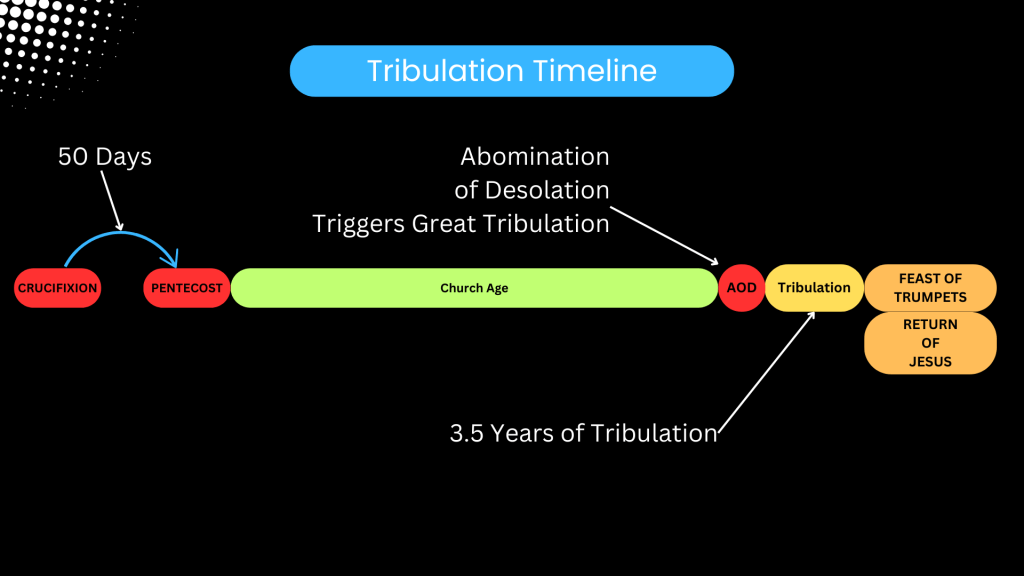
Now let’s take a look a first look at the Tribulation Timeline as we’ve discussed thus far.
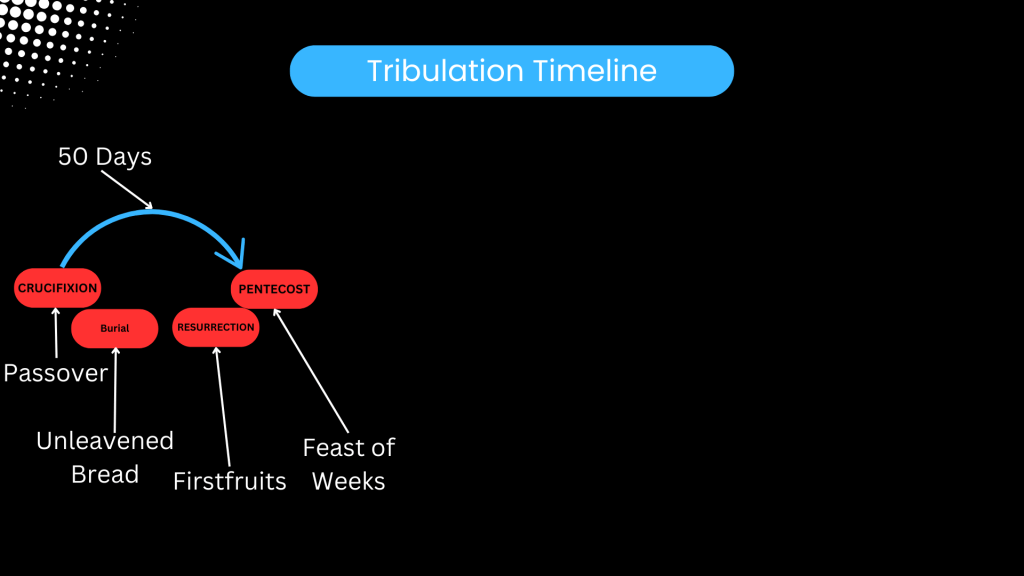
We know that the first 4 feasts are fulfilled by Christ’s crucifixion, burial, resurrection, and Pentecost – the reception of the holy spirit.
And we know that just as the Feast of Weeks was 50 days after Passover, so was the receipt of the holy spirit on Pentecost. That’s what the word means. 50 days.
Upon receipt of the holy spirit, the church age begun. And we’ve been in the church age now for 1996 years. On the year 2030, it will have been 2000 years. If you follow some channels, the make the claim that the return of Christ is in 2030 or 2033 depending on which date they believe to be the death of Christ. I make no claim, though I do find it interesting. And if true, we would expect to see the Antichrist cause the abomination sometime early next year or 2030 – again, depending on your belief. And like I said, I make no claim to know the year of the return of Jesus.
But what I do know is that the Abomination of Desolation does trigger the final 3 and a half years of the Tribulation – officially counting down the clock to the return of Jesus on, I believe, the Feast of Trumpets.
As we continue our study through the Tribulation period, we’ll expand on this timeline.
References
Fruchtenbaum, A. G. (2005). The footsteps of the Messiah: A study of the sequence of prophetic events (Rev. ed.). Ariel Ministries.
Hoehner, H. W. (1977). Chronological aspects of the life of Christ. Zondervan.
Rosenfeld, D. (n.d.). The Passover lamb and modern practice. Aish.com. Retrieved from https://www.aish.com
 The Scripture Retreat
Leave a comment